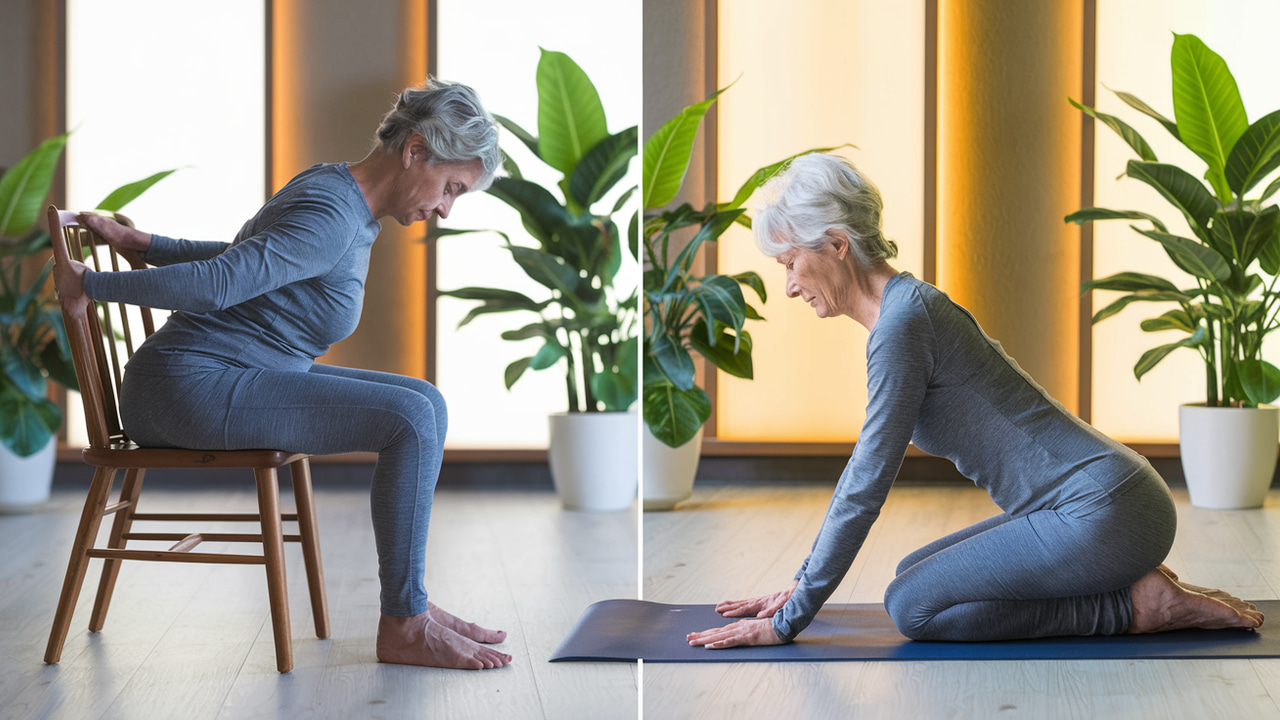
Chair Yoga vs Floor Yoga: Which Is Best for Over-40 Beginners?
What You’ll Learn
In this article, we’ll delve into the key differences between Chair Yoga and Floor Yoga, helping you decide which practice aligns best with your needs as an over-40 beginner. We’ll cover:
– Accessibility and Mobility
– Physical Benefits
– Mental Well-being
– Equipment and Space Requirements
– Progression and Adaptability
Quick Comparison Table
| Feature | Chair Yoga | Floor Yoga |
|---|---|---|
| Accessibility | High; designed for individuals with mobility issues or those who find it challenging to get on the floor. | Moderate; may be challenging for those with mobility issues due to the need to get on and off the floor. |
| Physical Benefits | Improves flexibility, strength, balance, and posture; aids in managing conditions like arthritis and osteoporosis. | Enhances flexibility, strength, balance, and endurance; offers a more comprehensive range of poses for a full-body workout. |
| Mental Well-being | Promotes relaxation and stress reduction through breathing and mindfulness practices. | Encourages mindfulness and stress reduction; may offer a deeper meditative experience due to longer practice sessions. |
| Equipment and Space Requirements | Requires a sturdy chair; minimal space needed. | Requires a yoga mat; more space needed to perform various poses safely. |
| Progression and Adaptability | Suitable for beginners; can progress to more traditional yoga practices as mobility improves. | Offers a wide range of poses; may require modifications for beginners or those with limited mobility. |
Overview of Chair Yoga
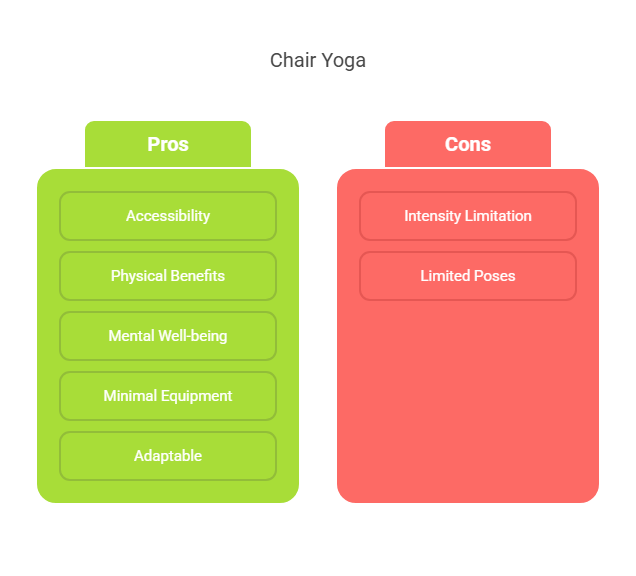
Chair Yoga is a modified form of traditional yoga that adapts poses to be performed while seated or using a chair for support. This practice is particularly beneficial for individuals over 40 with limited mobility, balance issues, or those seeking a gentler introduction to yoga.
Pros
– **Accessibility**: Designed for individuals with mobility issues or those who find it challenging to get on the floor.
– **Physical Benefits**: Improves flexibility, strength, balance, and posture; aids in managing conditions like arthritis and osteoporosis.
– **Mental Well-being**: Promotes relaxation and stress reduction through breathing and mindfulness practices.
– **Equipment and Space Requirements**: Requires a sturdy chair; minimal space needed.
– **Progression and Adaptability**: Suitable for beginners; can progress to more traditional yoga practices as mobility improves.
Cons
– **Intensity Limitation**: Chair yoga has a limited-intensity workout. You will not experience intense sweating as in traditional yoga.
– **Limited Range of Poses**: As you are using a chair for support, it will limit your experience and excitement in your yoga practice. ([nirvahealth.com](https://www.nirvahealth.com/blog/chair-yoga-vs-traditional-yoga?utm_source=openai))
Overview of Floor Yoga
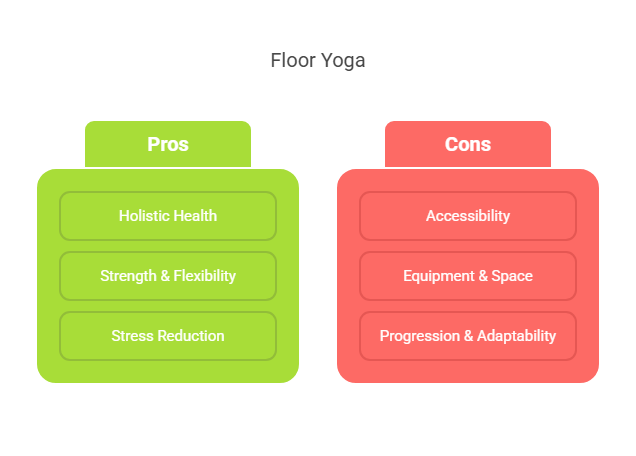
Floor Yoga, or traditional yoga, involves performing poses on a mat, transitioning between standing, seated, and floor-based positions. This practice is ideal for individuals over 40 without significant mobility constraints, seeking a more traditional yoga experience.
Pros
– **Holistic Health Benefits**: Traditional yoga is entirely holistic. It doesn’t just concentrate on perfecting postures; its significant benefits come from mental and spiritual aspects. ([nirvahealth.com](https://www.nirvahealth.com/blog/chair-yoga-vs-traditional-yoga?utm_source=openai))
– **Strength and Flexibility**: Most of the postures in traditional yoga can be completely weight-bearing, increasing strength and flexibility.
– **Stress Reduction**: Emphasizes controlling your breathing, creating a balance in your inner energy and thus having a significant effect on your stress hormones. ([nirvahealth.com](https://www.nirvahealth.com/blog/chair-yoga-vs-traditional-yoga?utm_source=openai))
Cons
– **Accessibility**: May be challenging for those with mobility issues due to the need to get on and off the floor.
– **Equipment and Space Requirements**: Requires a yoga mat; more space needed to perform various poses safely.
– **Progression and Adaptability**: Offers a wide range of poses; may require modifications for beginners or those with limited mobility.
Side-by-Side Breakdown
Accessibility and Mobility
– **Chair Yoga**: High accessibility; designed for individuals with mobility issues or those who find it challenging to get on the floor.
– **Floor Yoga**: Moderate accessibility; may be challenging for those with mobility issues due to the need to get on and off the floor.
Physical Benefits
– **Chair Yoga**: Improves flexibility, strength, balance, and posture; aids in managing conditions like arthritis and osteoporosis.
– **Floor Yoga**: Enhances flexibility, strength, balance, and endurance; offers a more comprehensive range of poses for a full-body workout.
Mental Well-being
– **Chair Yoga**: Promotes relaxation and stress reduction through breathing and mindfulness practices.
– **Floor Yoga**: Encourages mindfulness and stress reduction; may offer a deeper meditative experience due to longer practice sessions.
Equipment and Space Requirements
– **Chair Yoga**: Requires a sturdy chair; minimal space needed.
– **Floor Yoga**: Requires a yoga mat; more space needed to perform various poses safely.
Progression and Adaptability
– **Chair Yoga**: Suitable for beginners; can progress to more traditional yoga practices as mobility improves.
– **Floor Yoga**: Offers a wide range of poses; may require modifications for beginners or those with limited mobility.
Which One Should You Choose?
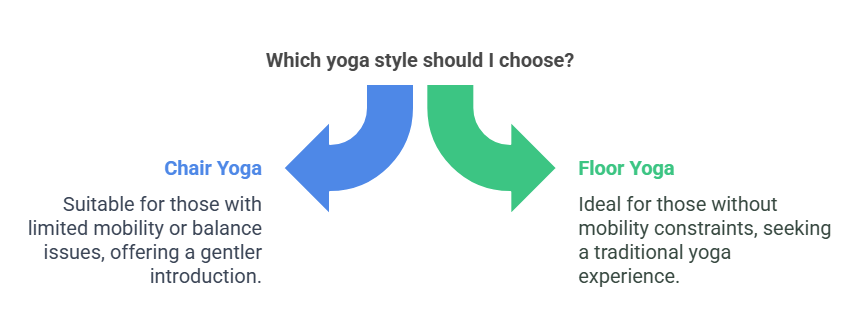
Your choice between Chair Yoga and Floor Yoga depends on your individual needs and goals:
– **Chair Yoga**: Best for individuals over 40 with limited mobility, balance issues, or those seeking a gentler introduction to yoga.
– **Floor Yoga**: Ideal for individuals over 40 without significant mobility constraints, seeking a more traditional yoga experience.
Chair Yoga vs Floor Yoga: The Final Verdict
| Category | Chair Yoga | Floor Yoga |
|---|---|---|
| Best for Beginners | ✔️ | |
| Best for Power Users | ✔️ | |
| Best Value | ✔️ |
Findings and Recap
In summary, both Chair Yoga and Floor Yoga offer unique benefits tailored to different needs. Chair Yoga provides a gentle, accessible introduction to yoga, making it ideal for those over 40 with mobility challenges. Floor Yoga offers a more traditional practice, suitable for individuals without significant mobility constraints seeking a comprehensive workout.
Related reading: Your Link Title
AI Image Prompt: A descriptive prompt for generating a featured image (e.g., “Photorealistic image of a person choosing between two yoga practices: one seated in a chair performing chair yoga, and the other on a yoga mat performing floor yoga, in a serene indoor setting.”)
“`html
Frequently Asked Questions
What is the main difference between Chair Yoga and Floor Yoga?
Chair Yoga adapts traditional yoga poses to be performed while seated or using a chair for support, making it accessible for individuals with mobility challenges or those who find it difficult to get on the floor. Floor Yoga involves performing poses on a mat, requiring the ability to get up and down from the floor. Both practices offer unique benefits tailored to different needs and preferences.
Who can benefit from Chair Yoga?
Chair Yoga is beneficial for individuals of all ages, especially those with limited mobility, older adults, office workers, and anyone seeking a gentle form of exercise. It helps improve flexibility, strength, balance, and mental well-being without the need to get on the floor. ([womanshospital.com](https://womanshospital.com/blog/entry/what-is-chair-yoga-and-who-is-it-best-for?utm_source=openai))
Can Chair Yoga help with weight loss?
While Chair Yoga is a low-impact exercise that can contribute to overall physical activity, it may not burn as many calories as more intense forms of yoga. However, it can aid in weight loss by increasing physical activity, improving metabolism, and reducing stress, which may help control emotional eating. ([reverse.health](https://reverse.health/blog/chair-yoga-vs-regular-yoga?utm_source=openai))
Is Chair Yoga suitable for beginners?
Yes, Chair Yoga is an excellent option for beginners. It offers a gentle introduction to yoga, allowing individuals to learn poses and breathing techniques without the intimidation of floor-based practice. The use of a chair provides support and stability, making it easier to perform movements safely. ([webmd.com](https://www.webmd.com/fitness-exercise/features/chair-yoga-poses/?utm_source=openai))
How does Chair Yoga compare to traditional Floor Yoga in terms of benefits?
Both Chair Yoga and Floor Yoga offer benefits such as improved flexibility, strength, balance, and mental well-being. Chair Yoga provides these benefits in a more accessible manner, making it suitable for individuals with mobility issues or those who prefer not to get on the floor. Floor Yoga may offer a broader range of poses and deeper stretches due to the ability to move freely on a mat. ([health.harvard.edu](https://www.health.harvard.edu/staying-healthy/yoga-for-everyone?utm_source=openai))
Can I practice Chair Yoga at home or do I need to attend a class?
Chair Yoga can be practiced both at home and in a class setting. Many online resources and videos are available for home practice, allowing you to follow along at your own pace. Additionally, community centers, fitness facilities, and yoga studios often offer Chair Yoga classes for those who prefer a guided experience. ([webmd.com](https://www.webmd.com/fitness-exercise/features/chair-yoga-poses/?utm_source=openai))
What equipment do I need for Chair Yoga?
The primary equipment needed for Chair Yoga is a sturdy chair with a straight back and no arms, ensuring stability and safety during practice. No special clothing or additional props are required, making it a convenient and accessible form of exercise. ([webmd.com](https://www.webmd.com/fitness-exercise/features/chair-yoga-poses/?utm_source=openai))
“`